Why "No Pain, No Gain" Doesn't Apply After 60
Ask anyone who grew up playing sport, going to the gym, or following a fitness programme and they will probably have heard some version of the same phrase: no pain, no gain. Push harder. Go further. Feel the burn.
It is one of the most deeply embedded ideas in Western fitness culture — and for many younger, healthy adults in high-intensity training, there is a kernel of truth to it. Muscle growth does require progressive overload. Cardiovascular fitness does improve when the heart is challenged.
But for adults over 60, applying this philosophy to exercise is not just unhelpful. In many cases, it is actively counterproductive — and understanding why is one of the most important things an older adult, or anyone caring for one, can know.
Why "No Pain, No Gain" Gets It Wrong for Older Adults
The human body changes significantly across the decades. By the time most people reach their 60s, several physiological shifts are well underway:
- Muscle mass declines — sarcopenia (age-related muscle loss) typically begins in the 40s and accelerates after 65, reducing strength and stamina
- Joints become more vulnerable — cartilage thins over time, and conditions like osteoarthritis become increasingly common; impact loading that was manageable at 35 can cause real harm at 65
- Recovery takes longer — the inflammatory response to exercise that drives muscle adaptation in younger adults is slower and less efficient in older bodies; overexertion does not just hurt more, it takes longer to heal from
- Balance becomes a risk factor — as proprioception (the body's sense of position) declines, activities that challenge balance carry genuine fall risk
When an older adult pushes through pain during exercise — as "no pain, no gain" encourages — they are not building resilience. They are often masking warning signals that the body is sending for good reason.
What the Research Actually Says About Exercise After 60
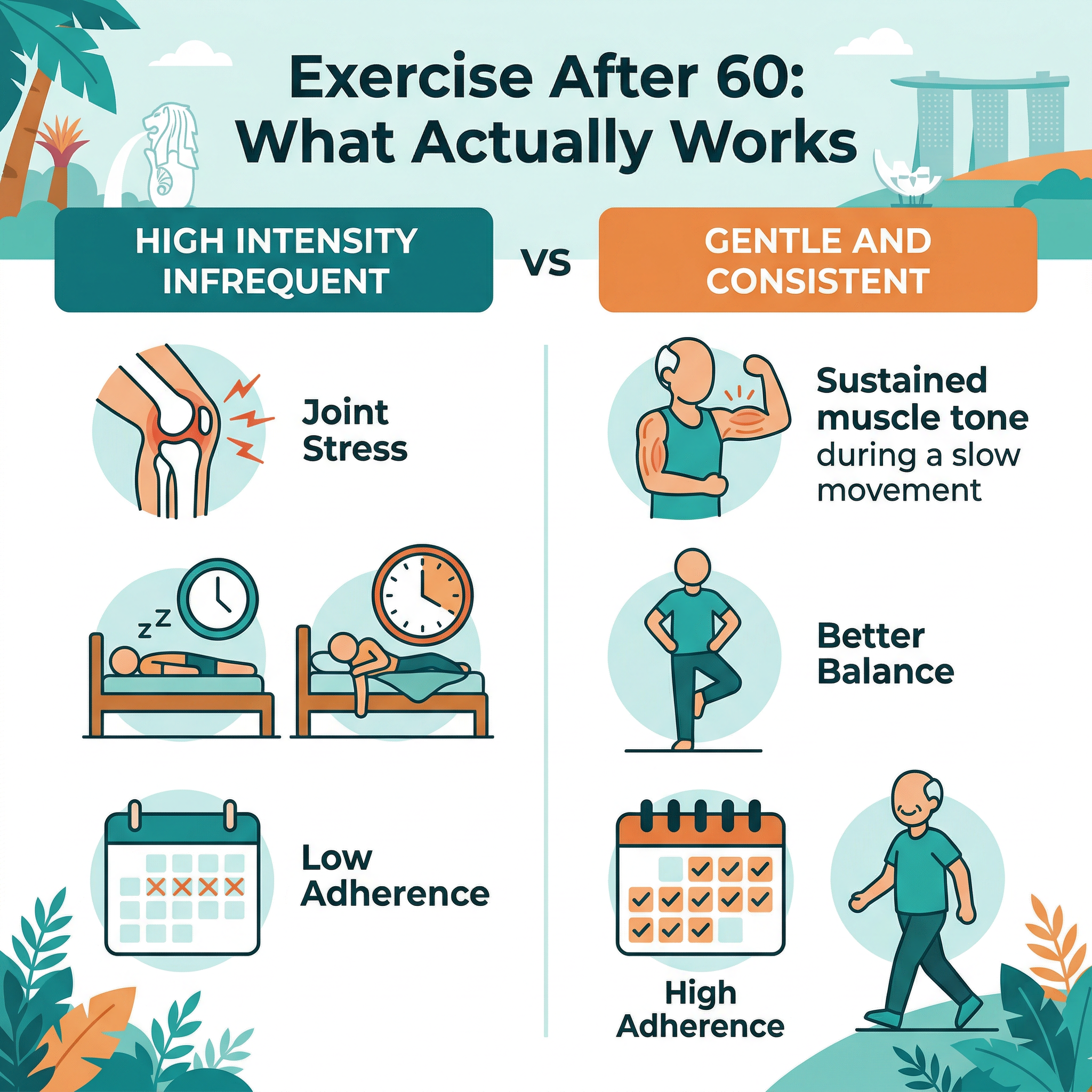
The evidence on exercise for older adults points consistently in the same direction: gentle, consistent, and sustainable beats intense and infrequent.
Studies on older adult populations have shown that:
- Low-to-moderate intensity exercise performed regularly is associated with better long-term mobility outcomes than high-intensity training done sporadically
- Strength improvements in older adults can be achieved with significantly lighter loads than traditionally assumed — the key variable is consistency, not intensity
- The psychological barriers to exercise in older adults are strongly linked to fear of pain, injury, and exertion — approaches that reduce these barriers produce far better participation and adherence
In other words, the best exercise for an older adult is one they will actually do — repeatedly, safely, and without dread.
The Problem With Most Exercise Advice for Seniors
Walk more. Join a class. Use the machines at the community centre. The intention behind this advice is good. The execution is often misaligned with the reality of how many older Singaporeans live.
Consider someone in their late 60s managing osteoarthritis in both knees, a mild fear of falling, and the fatigue that comes with disrupted sleep. For this person:
- Walking long distances is uncomfortable and feels risky
- Group exercise classes move at a pace that causes anxiety
- Gym machines require a level of coordination and confidence that many older adults do not have — not because of weakness, but because they have never been taught how to use them safely
The result is avoidance. And avoidance accelerates the very decline the advice was trying to prevent.
A Different Approach: Low Threshold, High Consistency
What works for older adults is not less exercise dressed up as exercise. It is genuinely low-threshold activity that produces real physiological benefit — movement that does not require the person to overcome a significant psychological or physical barrier every single time they do it.
This is the principle behind passive exercise through whole body vibration technology. Rather than asking the body to exert effort, the technology delivers controlled mechanical vibrations that trigger the body's natural muscle responses — up to 30 to 50 involuntary muscle contractions per second — without any conscious effort, impact loading, or balance challenge.
The result is genuine physiological engagement — improved local circulation, gentle muscle activation, lymphatic stimulation — without the exertion, the soreness, or the recovery time that conventional exercise requires.
For someone who cannot walk comfortably, has a fear of falling, or is managing post-surgical recovery, this is not a compromise. It is often the only viable path to regular physical activity.
What "Gentle and Consistent" Looks Like in Practice
The practical application of the "gentle and consistent" principle looks different for every individual. But some common principles apply:
- Frequency over intensity — three shorter sessions per week will consistently outperform one intense session, in terms of both physiological benefit and sustainability
- Remove friction — the more effort it takes to start, the less likely it will happen. The ideal wellness activity for an older adult requires no special clothing, no travel to a venue, no warm-up ritual, and no recovery time
- Build on success, not failure — beginning with activity that feels comfortable and manageable builds confidence and momentum; beginning with activity that causes pain or exhaustion does the opposite
- Progress is real, but subtle — improved circulation, better sleep, less stiffness on waking, more confidence walking — these are real outcomes that may not look impressive on a fitness tracker, but represent meaningful improvements in daily quality of life
A Note for Adult Children and Caregivers
If you are trying to encourage an older parent to exercise, the "no pain, no gain" message is almost certainly making the conversation harder, not easier. When exercise is framed as something that requires effort and discomfort, resistance is the natural and rational response.
Reframing the conversation around comfort, ease, and gentle consistency — and introducing options that genuinely deliver on that framing — changes the dynamic entirely.
Many of our visitors at the Vibrahealth Wellness Lounge are adult children who came in on behalf of a parent. They wanted to find something that their mum or dad would actually use — without the arguments, the guilt, or the disappointment of an unused gym membership. If that resonates, our gift options for parents are a good place to start.
Frequently Asked Questions
Is some discomfort during exercise normal after 60?
Mild muscle fatigue after moderate activity is generally normal. Sharp pain, joint pain, or pain that persists after exercise is not — and should not be pushed through. When in doubt, consult a doctor or physiotherapist before continuing or starting a new activity.
What is the safest form of exercise for elderly people with joint pain?
Low-impact options generally include swimming, water aerobics, seated stretching, and tai chi. Whole body vibration through seated passive exercise is increasingly used alongside these, as it produces muscle activation and circulation benefits without joint loading. Always consult your doctor if you are managing a specific condition.
Can elderly people build muscle after 60?
Yes. Research consistently shows that older adults can build and maintain muscle mass with appropriate resistance training. The key difference from younger adults is that lighter loads, longer recovery periods, and consistent programming produce better outcomes than high-intensity approaches.
How often should seniors exercise?
Singapore's Health Promotion Board recommends at least 150 minutes of moderate-intensity physical activity per week for adults, including older adults. For those with mobility limitations, regular gentle movement — even 10–15 minutes daily — is far more valuable than occasional intense effort.
Vibrahealth offers complimentary sessions at our Wellness Lounge at The Adelphi, Singapore. If you or your parent is looking for a gentle, low-threshold wellness option, get in touch or WhatsApp us to find out more.
Our products are general wellness equipment. They are not medical devices and are not intended to diagnose, treat, cure, or prevent any medical condition. Please consult a qualified healthcare professional before making changes to your health routine.